When Linthoi Chanu Ningthoukam became the first Indian girl to win a gold medal at the World Cadet Judo Championships in 2022, national media ran the story for a day. Then moved on. When she won again, the coverage was thinner. She is from Manipur. That detail, rarely stated plainly, explains most of what follows.
NESPORTS FOUNDATION works across all eight states of Northeast India — Arunachal Pradesh, Assam, Manipur, Meghalaya, Mizoram, Nagaland, Sikkim, and Tripura. Together these states have produced national champions in boxing, wrestling, archery, wushu, judo, weightlifting, football, and athletics. They have also produced, year after year, athletes who win medals at nationals and international events and return to silence: no sponsors, no press, no pathway to sustain a career.
What We Actually See on the Ground
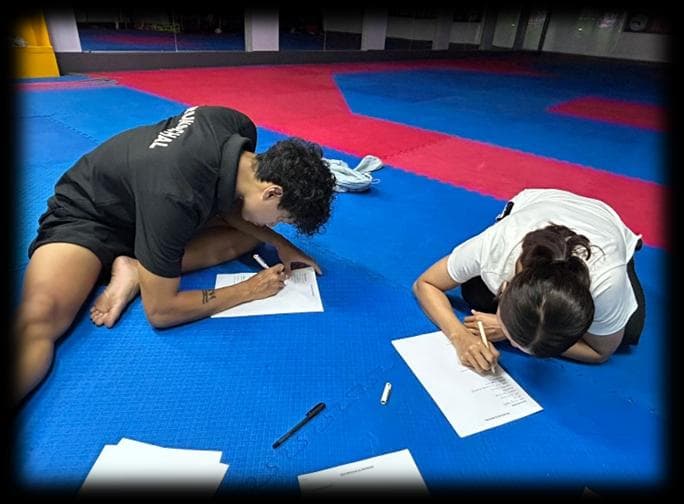
We run a sports psychology programme called Game Ready. In 2025–2026, we delivered fifteen pre-event workshops to 229 athletes — boxers, wrestlers, netball players, footballers, judokas, powerlifters, and para-sport competitors heading into national tournaments.
In almost every session, the same issues surface. Athletes travel to nationals without proper kits because the district associations ran out of funds — or never had them. They sleep four to a room on the road. They have had no physiotherapy, no nutrition guidance, and no mental performance support. For many of them, our two-hour workshop before the tournament is the first sports science intervention they have ever received in their careers.
This is not a fringe problem. This is standard. These are not athletes who gave up early. These are athletes who qualified for national-level competition through sheer physical talent, trained with minimal infrastructure, and still made it that far. What they lack is everything that surrounds training in states with better-resourced sports ecosystems.
The Funding Gap Is Structural, Not Accidental
Northeast India receives a fraction of national sports sponsorship. Corporate India, when it does invest in sport, overwhelmingly directs money toward cricket and toward athletes from states with large media markets. The calculation is simple and rarely challenged: sponsors want eyeballs, and Northeast India has fewer of them in the metrics that matter to brand managers in Mumbai and Delhi.
Khelo India has put money into infrastructure. The National Sports Development Fund exists. Sports Authority of India runs academies in the region. These are real. But infrastructure without a surrounding ecosystem — physiotherapy, mental performance, travel funding, media coverage, corporate sponsorship — produces athletes who can qualify for nationals and then stall there, unable to sustain the costs of competing at the next level.
We run a scouting programme and a support fund called NESF GameOn specifically because we see what falls through those gaps. In 2025, our scouting trial at HDMT shortlisted 18 athletes for individual assessment. Several of them had strong performances at state level but zero external support. What they needed was not a two-week camp. What they needed was someone to pay for their travel to the next tournament and to keep paying, consistently, over two or three years while they developed.
The Media Problem
We run NESports.in, a dedicated sports news portal for the region. We built it because the alternative was watching Northeast sport not exist in print. National sports media does not cover this geography systematically. There is no national sports desk that monitors state-level results from Mizoram. There is no panel on primetime that asks whether the Northeast had anyone in the para-sport finals last month.
Regional language media covers local tournaments. But the coverage does not reach national audiences, does not build the name recognition that attracts sponsors, and does not apply pressure on national bodies to allocate resources equitably. The silence is not benign. It has material consequences for athletes whose careers depend on visibility.
What We Are Saying, Plainly
Northeast India produces talent that should be winning more medals for India at senior international level. It is not, at the rate it should, because the support system that converts talented juniors into sustained senior performers does not exist here at the scale it exists elsewhere. That gap is the result of underinvestment — in infrastructure, in sports science support, in media, and in sponsorship — that tracks closely with the region's distance from where economic and political attention concentrates in India.
We are not saying this to criticise any individual body. We are saying it because it is true and because if it goes unsaid publicly, it changes nothing.
NESPORTS FOUNDATION exists to do what we can within that reality. We deliver sports psychology where there is none. We scout athletes who would otherwise not be assessed. We fund competition travel when there is no other source. We build media capacity so the stories exist in public record. None of this solves the structural problem. We know that. We do it because the athletes in front of us need it now, and because the documentation of what is missing is itself a form of pressure.
Every article we publish here, every athlete profile we write, every workshop report we post — these are part of a record. A record that says: this athlete existed, this gap existed, this support was needed and was or was not there. We will keep adding to it. Irrespective of whether it is comfortable to read.